


Which Direction to Sleep In (According to Science and Ancient Tradition)?
Written by: Gabrielle Talan
Gabrielle, a former insomniac turned sleep writer, brings over a decade of content expertise to her work. For the past 3 years, she's focused exclusively on sleep topics – a happy choice that helps give her the deep and restful sleep she craves.
Curious if the direction you sleep in impacts your sleep quality? According to Feng Shui and Vastu Shastra, it just might. They suggest that aligning yourself in specific directions improves the flow of natural energy, which promotes better sleep and overall health and well-being.
Meanwhile, science also has its say regarding which direction to sleep in. Limited research postulates that aligning with the Earth's magnetic field might affect your body's circadian rhythms and improve sleep quality.
This article explains which direction to sleep in for optimal rest and why, from the perspective of ancient tradition and modern science. You'll also learn how to choose the direction to sleep in.
Let's get started.
Key Takeaways
-
Preliminary research suggests sleeping with your head pointing southward is the best direction, but no conclusive evidence supports this.
-
Ancient traditions like Feng Shui and Vastu Shastra recommend sleeping with the crown of your head facing southward. It's believed that aligning with the earth's magnetic field improves sleep quality, health and well-being. Note that scientific validation is lacking for this belief.
-
Avoid sleeping with your head facing towards the north and west, according to Vastu Shastra.
-
Sleeping direction isn't the primary factor influencing sleep quality. Good sleep hygiene, ideal sleeping position, and a cool, quiet, dark bedroom play more significant roles.
Table of Contents
Which Direction to Sleep In for the Best Rest Possible
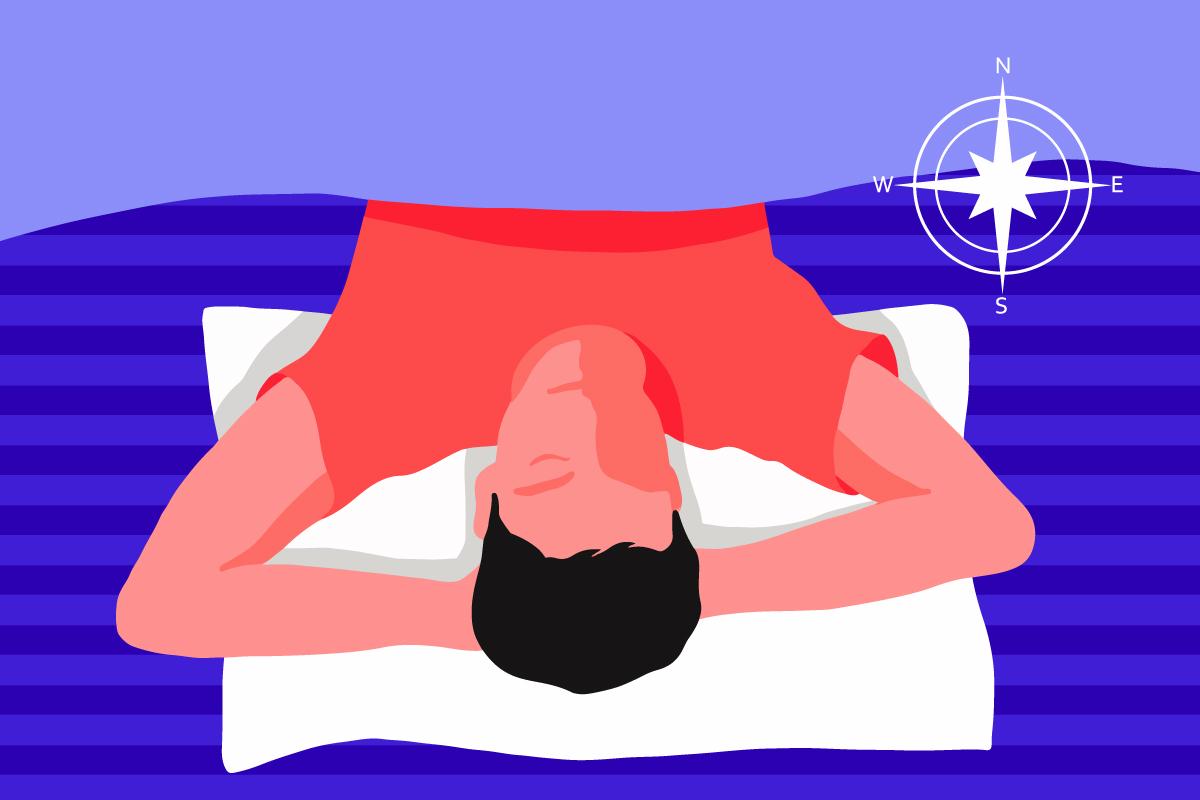
The best sleeping direction is probably the south, where your head is pointed towards the south, and your feet to the north as you lie down.
Sleep orientation, however, differs according to where you live. Southward is the best direction if you live in the northern hemisphere. You can also consider sleeping facing the east, but avoid the west and the north.
Meanwhile, any direction except the south is ideal if you live in the southern hemisphere.
What Does Science Say Is the Best Sleeping Direction?
While the jury is still out on this one, the best direction to sleep is south. However, it's essential to understand that this isn't universal. No strong scientific evidence currently supports the link between sleeping direction and health.
Let's look at geomagnetic alignment, wherein the Earth's magnetic field runs in a north-south direction. The theory is that lying down with your head in the south direction aligns you with the Earth's energy flow, which might help you sleep more deeply and for longer.
A study published in eNeuro found that some humans sense the Earth's geomagnetic field, known as magnetoreception. While this has been proven true for animals, it remains inconclusive for humans.(1)
Also, research suggests that electromagnetic fields (EMFs) affect some people. A study published in the Biomedical Journal found that natural EMFs influence the circadian rhythm, your body's 24-hour clock that regulates your sleep-wake cycle.(2)
Sleeping in the south direction may also benefit blood flow. Some research suggests that sleeping southward helps lower blood pressure and improves sleep quality. However, this research is preliminary.
Sleeping towards the south is also recommended by traditional practices, which we'll discuss below.
Which Direction Does Vastu Shastra Recommend Sleeping in?
Sleeping towards the south is best for physical and mental health, according to Vastu Shastra, a traditional and ancient form of Indian architecture. The balance between nature and architecture is at the forefront of this practice.
Vastu Shastra draws from the concept that aligning the human body with the Earth's magnetic field improves sleep and overall health, including better blood circulation.
Also, sleeping with your head facing southward and your feet northward supposedly attracts prosperity and wealth.
Meanwhile, sleeping in a northeast or southeast direction isn't recommended. Sleeping southeast may cause sickness, while sleeping northeast may cause anxiety, according to Housing.com.(3) Anxiety causes restless sleep or makes it difficult to fall asleep.
What Direction Should You Sleep in Feng Shui?

The best sleeping direction is the south, according to Feng Shui, an ancient Chinese practice wherein you arrange your living space and household objects to create balance and establish harmony for a positive energy flow (also known as chi). Chi is the life force flowing through all things, believed to improve your overall well-being and health.
Placing your bed facing south is the best direction to sleep. However, to attract good health and wealth, you'll also need to consider the commanding position, wherein you can see your bedroom door, but your bed isn't directly aligned with the door line.
Another option is a bed placement facing east, which encourages better focus and health.
According to Feng Shui Diva, experts may also recommend the direction to sleep based on your kua number.(4) This number is determined by your birth year and gender.
For instance, if your kua number is 1, sleeping with your head pointed toward the south direction benefits family and marriage harmony. Meanwhile, sleeping in a southeast direction attracts money and benefits your career.
How Bad Is It to Sleep in Other Directions?
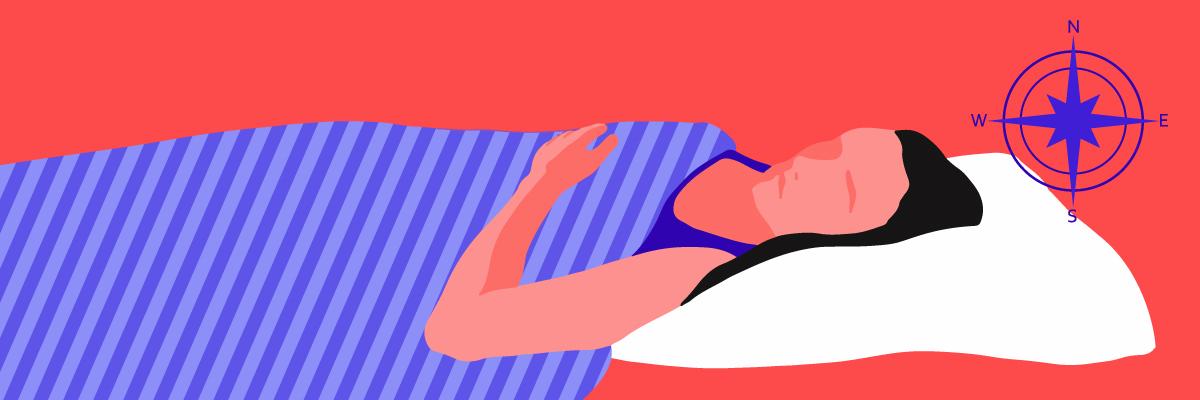
Now you know the best directions to sleep according to science and ancient traditions. Let's move on to what you potentially need to avoid.
Is It Okay to Face East When Sleeping?
According to Vastu Shastra and science, sleeping facing the east is fine.
Sleeping with your head facing the east may benefit memory, focus and good health. It's the second-best sleeping direction, according to Vastu Shastra. If you need a creativity boost or are facing health issues, sleeping eastward is ideal, says Vastu Consultant.(5) Furthermore, sleeping with your head pointed towards the east aligns you with the sunrise, which symbolizes positive energy and rebirth.
Also, some evidence suggests that sleeping in an east-to-west position decreases the time it takes to reach the first Rapid Eye Movement (REM) sleep stage. Furthermore, research published in the International Journal of Neuroscience indicates that the direction we face while sitting can influence our brain activity, specifically alpha brain waves.(6) These waves are closely linked to relaxation, but more research is needed to confirm these effects.
Is It Bad to Sleep Facing North?
What about sleeping in a north-south position with your head facing north and feet pointing south?
From the perspective of Vastu Shastra, sleeping with your head facing north isn't advisable. Sleeping in the north direction causes a drop in energy and productivity upon waking.
Meanwhile, from a scientific perspective, sleeping with your head facing a north direction and your feet towards the south goes against the direction of the Earth's geomagnetic field. This might negatively affect your sleep quality.
Is It Bad to Face West While Sleeping?
Vastu Shastra recommends avoiding sleeping with your head pointed towards the west. Sleeping in this direction goes against the Earth's electromagnetic field, which may negatively impact your health and result in disturbed sleep.
Some Vastu Shastra practitioners believe sleeping with your head facing westward may also decrease motivation and cause restlessness. So, if you're struggling at work or gunning for that promotion, this is a sleeping direction you'll want to avoid if you want to improve performance and focus.
Feng Shui is more flexible in this aspect. Indeed, some practitioners don't recommend sleeping facing the west, but it isn't universal.
Remember that Feng Shui also uses your kua number to determine the direction in which you should sleep. However, as mentioned earlier, it emphasizes placing your bed in a commanding position as the primary basis for sleep direction.
Does Sleeping Direction Really Matter
From a scientific point of view, the short answer is not really. While some studies we mentioned above have made a case for a potential link between sleep direction and health, there simply isn't enough evidence to make it conclusive.
The biological effect of geomagnetism on your body is so minute that it won't make a significant difference. The ideal room temperature (60 to 70 degrees Fahrenheit), sleeping in pitch darkness and your sleep posture have a much larger impact on your sleep health.
How to Choose the Best Direction to Sleep in
Science and ancient traditions may say the south is the ideal sleeping direction. However, this isn't the only consideration when determining what suits you best for restful sleep. Yes, you read that right: It's also a matter of personal preference.
You'll need to experiment with what sleeping direction suits you best. Here are a few guidelines:
-
According to Resmed, keep a log of how well you sleep in the current sleeping direction for at least a week to establish a baseline.(7) Jot down your sleep quality, duration and energy levels upon awakening. A sleep journal is a helpful tool for this exercise.
-
Try out different sleeping directions as your room area permits. If your space is limited, experiment with as many directions as possible. Make sure you allot enough time per sleeping direction for comparison. Jot down your findings in your sleep journal.
-
Consider how each position makes you feel security-wise. For instance, if sleeping facing the door or under a window makes you anxious, position your bed in another direction. (By the way, Feng Shui advises against both bed positions.)
-
Consider other factors affecting your sleep and maintain them throughout your directional experiments. Among these are room temperature, comfortable bedding and light levels. (In case you didn't know, total darkness is ideal for optimal sleep quality. If you can't control this factor, consider a 100% blackout sleep mask.)
-
You should also explore the best side to sleep on and other sleeping positions, like the supine sleep position or the prone sleep position. Sleep positions also affect sleep quality and health. For instance, sleeping on your left side may ease symptoms of acid reflux and sleep apnea.
-
If you share a bed, it's essential to consider your partner's comfort levels. What works for you might not work for them.
-
When you're done experimenting, review your findings per direction. This will help you determine the right sleeping direction for you.
A word on getting sound sleep: sleep direction shouldn't be your sole concern. There are many other factors to consider, like sleep hygiene, position and mental and physical state before hitting the sack.
Sleep doctor Dr. Chester Wu told Rise Science: “There's not much solid research into the best direction to sleep in. But we know much more about how important it is to be calm and relaxed before bed.”(8)
How to Set Up Your Room For Better Sleep
There are other factors to consider when setting up the ideal sleep environment.
According to Vastu Shastra
Try positioning your bed in the Southwest corner of your room. Make sure your headboard is against a solid wall, but avoid pushing the sides of the bed flush into a corner. Leave a few inches of space between the bed and the wall so that the energy circulates freely.
Vastu recommends keeping the area under your bed clutter-free. Consider, too, avoiding heavy overhead fixtures like exposed ceiling beams. These can cause stress subconsciously. Avoid placing mirrors directly facing your bed, as it's believed to drain energy and cause restless sleep.
According to Feng Shui
Feng Shui advises positioning your bed in what's known as the "commanding position." It's basically placing your bed where you can see the door without your feet pointing directly towards it. Ensuring your headboard is against a solid wall instead of a window prevents energy from leaking.
Leave equal clearance on both sides of the bed and use matching nightstands and table lamps. Feng Shui is big on harmony and balance. As with Vastu Shastra, don't position mirrors facing the bed and keep the area underneath it clutter-free.
According to Western Science
Modern science recommends placing your bed against a wall with a clear view of doorways, much like Feng Shui's "commanding position." The logic behind it is psychological. It allows your subconscious to relax because you can spot threats without being too close to them. It's also ideal for avoiding drafts.
Just like in Feng Shui and Vastu Shastra, modern science also encourages keeping the underside of your bed clutter-free. It's more about trapping dust and allergens that can cause respiratory difficulties that disrupt sleep.
Modern science also advises against placing mirrors directly facing your bed. Biologically, the brain is wired to detect movement. A mirror facing the bed can reflect something harmless (like a blanket moving), triggering the brain's fight-or-flight response. A mirror can also reflect LED lights from electronics, which can disrupt your sleep cycle. Humans require absolute darkness to sleep well. Darkness triggers the release of melatonin, the sleep hormone.
What to Do if You Still Have Trouble Sleeping
What if you've explored the different directions but still struggle to get a good night's sleep? As mentioned earlier, don't get disheartened because sleeping orientation is just one of several factors influencing sleep quality.
You can still get restful sleep by:
-
Establish a consistent sleep schedule, which means going to bed and waking up every day at the same time (weekends included).
-
Keep your bedroom dark, cool and quiet. Read our article on how to make your bedroom darker for tips.
-
Ditch the gadgets at least an hour before bed. Blue light represses the production of melatonin, the sleep hormone. It may also trick the human brain into thinking it's time to be alert and awake instead of asleep.
-
Consider changing the colors of your bedroom to ones that are more conducive to restorative sleep. Read our article on what colors help you sleep for more information.
-
Maintain a healthy diet and exercise regularly. However, don't do either too close to bedtime.
-
Consult a somnologist if you are having trouble sleeping. These professionals are trained in sleep medicine and can help identify an underlying sleep disorder like sleep apnea or insomnia, resulting in sleep deprivation.
Conclusion
We hope this article provides enough information on the best direction to sleep in. Remember that while science and ancient traditions like Feng Shui and Vastu Shastra recommend the south, it's also a matter of identifying what's best for you.
While sleeping direction might play a role, focusing on sleep hygiene is essential for restful and deep sleep, including optimizing your sleeping environment. Develop a healthy diet and exercise habits, too.
Frequently Asked Questions About Which Direction to Sleep In
Does the Earth’s Magnetic Field Influence How We Sleep?
The Earth’s magnetic field might have some influence on sleep and circadian rhythms. Limited research suggests that it can potentially affect brain activity, melatonin or sleep quality. However, the evidence in humans is mixed and limited, which makes it inconclusive. Factors like light exposure, stress and sleep habits are much more important.
What if My Room Doesn’t Allow Me to Sleep in the Ideal Position?
If your room doesn't let you sleep in the ideal position, modern science, Feng Shui and Vastu Shastra offer workarounds. Feng Shui and Vastu suggest using physical barriers, strategic mirrors or heavy furniture to redirect energy and restore harmony. Western science focuses on sensory tools like white noise machines and eye masks to block out noise and light. Your physical and psychological comfort are more important than adhering to rigid rules.
Can I Sleep Well Even if My Bed Faces the Wrong Direction?
Yes, you can sleep well even if your bed faces in the wrong direction. Absolute darkness, the ideal sleeping temperature and supportive bedding are more important than geography. Physical and psychological comfort are far more important than forcing a layout to satisfy a tradition. Optimize your bedroom by eliminating clutter, blocking out sensory disruptions with sleep masks or white noise, and establishing a consistent wind-down routine.
Sources:
(1) “Transduction of the Geomagnetic Field as Evidenced from alpha-Band Activity in the Human Brain.” eNeuro, www.eneuro.org/content/6/2/ENEURO.0483-18.2019. Accessed 01 June 2026.
(2) “Influence of electromagnetic fields on the circadian rhythm: Implications for human health and disease.” Biomedical Journal, www.sciencedirect.com/science/article/pii/S2319417023000033. Accessed 01 June 2026.
(3) “Best sleeping direction as per Vastu.” Housing.com, housing.com/news/best-direction-to-sleep-as-per-vastu/. Accessed 01 June 2026.
(4) “Your Best Compass Directions.” Feng Shui Diva, www.fengshuidiva.com/feng-shui-sleeping-directions. Accessed 01 June 2026.
(5) “Vastu and Sleeping Direction.” Vastu Consultant, vastuconsultant.com/vastu-sleeping-direction/. Accessed 01 June 2026.
(6) “Influence of the earth's magnetic field on resting and activated EEG mapping in normal subjects.” International Journal of Neuroscience, pubmed.ncbi.nlm.nih.gov/8169054/. Accessed 14 March 2025.
(7) “Best Direction to Sleep Scientifically for Restful Night.” Resmed, www.resmed.co.in/blogs/best-direction-to-sleep. Accessed 01 June 2026.
(8) “Best Direction to Sleep In? Sleep Expert Shares the Science.” Rise Science, www.risescience.com/blog/best-direction-to-sleep-in. Accessed 01 June 2026.
Disclaimer: The information contained in this website or provided through our blog, e-mails, or programs is for informational purposes only. It is not intended to be a substitute for medical advice, diagnosis or treatment that can be provided by your healthcare professionals.